
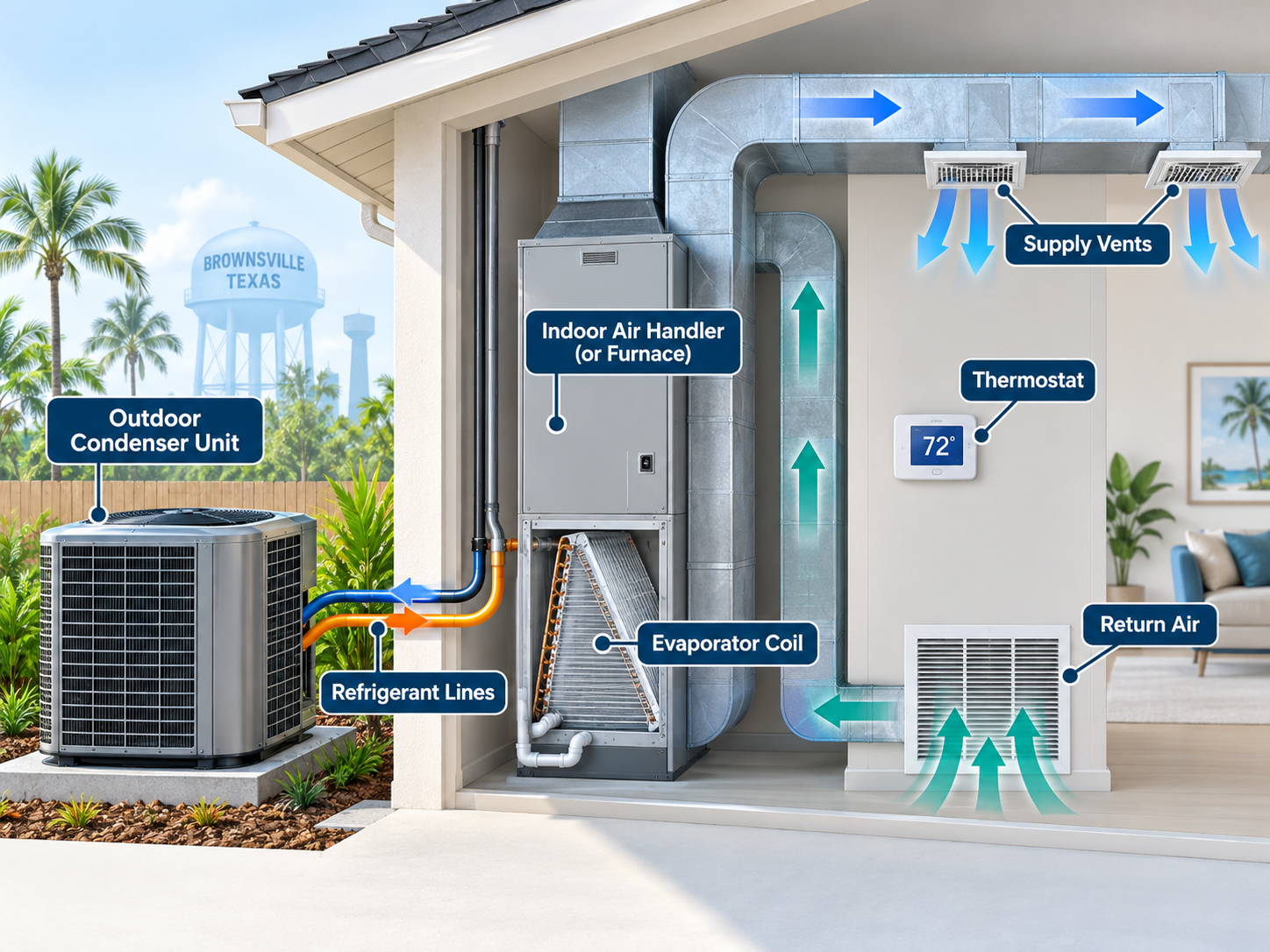
This guide walks through the refrigeration cycle, the components involved, and what happens when each one starts to fail — useful context whether you are diagnosing a problem or evaluating a quote.
The refrigeration cycle in four steps
- 1Evaporation: warm indoor air passes over the cold evaporator coil. Refrigerant inside the coil absorbs that heat and boils into a low-pressure vapor. Moisture in the air condenses on the coil and drains away — this is where dehumidification happens.
- 2Compression: the compressor in the outdoor unit squeezes that vapor, raising its pressure and temperature well above the outdoor air temperature.
- 3Condensation: the hot high-pressure vapor flows through the outdoor condenser coil while the fan blows outside air across it. The refrigerant rejects its heat and condenses back into a liquid.
- 4Expansion: the liquid passes through a metering device (usually a TXV), which drops its pressure sharply. It becomes cold again and returns to the evaporator coil to repeat the cycle.
The components and what they do
- Thermostat: senses room temperature and sends the 24-volt call for cooling
- Air handler / furnace blower: moves house air across the evaporator coil and through the ducts
- Evaporator coil: absorbs heat and moisture from the indoor air
- Refrigerant line set: the insulated suction line and smaller liquid line connecting indoors to outdoors
- Compressor: the pump that drives the entire cycle
- Condenser coil and fan: reject the collected heat to the outdoor air
- Metering device / TXV: controls how much refrigerant enters the evaporator
- Condensate pan, drain and float switch: carry away the water pulled out of the air
- Ductwork and registers: distribute conditioned air and return it for another pass
Why airflow matters as much as refrigerant
Heat transfer depends on moving enough air across the coil. A restricted filter, a fouled blower wheel, crushed ductwork or an undersized return all reduce airflow — and the coil responds by getting colder, not by cooling the house better. Below freezing, condensation on the coil turns to ice, which blocks airflow completely. That is why so many 'low refrigerant' complaints turn out to be airflow problems.
What this means for common symptoms
- Warm air with strong airflow: the refrigeration side is not working — compressor, charge or outdoor electrical
- Cold air with weak airflow: the air side is restricted — filter, coil, blower or ducts
- Ice on the lines: coil temperature below freezing from low airflow or low charge
- Water in the house: the condensate the system pulled from the air has nowhere to go
- High bills with adequate cooling: the system is working harder than it should — dirty coil, low charge, duct leakage
Dehumidification in a Gulf Coast home
In Brownsville, moisture removal is half the job. A system only dehumidifies while it runs, so short cycles — usually caused by oversized equipment — leave the air damp even when the thermostat is satisfied. This is why correct sizing and longer, lower-capacity run times produce better comfort here than raw capacity does.