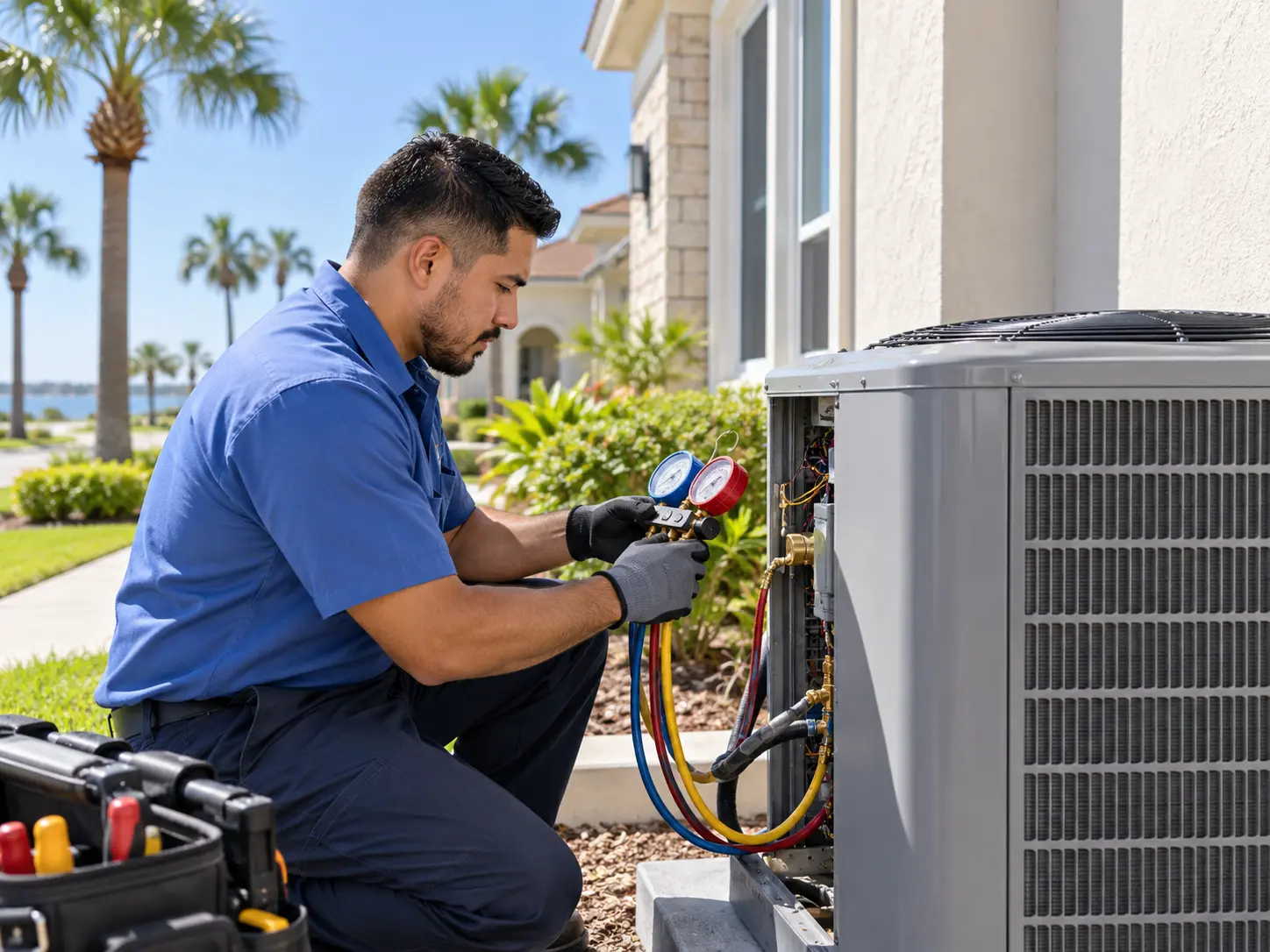
An emergency call typically starts with a quick conversation about what the system is doing: whether the outdoor unit is running, whether air is moving at the vents, whether the breaker has tripped, and whether anything is smoking, burning or flooding. Some situations can be stabilized over the phone in a couple of minutes. Response times depend on provider availability, current demand, location and the type of AC problem, and a responding HVAC professional may arrive with commonly used tools and parts for the most frequent failures.
What counts as an AC emergency in South Texas
Not every cooling problem needs a middle-of-the-night visit, but in a coastal subtropical climate the threshold is lower than in most of the country. Heat-related risk rises quickly for infants, older adults, anyone with a heart or respiratory condition, and pets left indoors.
- No cooling at all when the outdoor temperature is above 90°F
- A burning, hot-plastic or electrical smell coming from the air handler or condenser
- A breaker that trips again immediately after being reset
- Water pouring from the air handler closet, attic or ceiling below it
- Loud grinding, screeching or hammering noises from the outdoor unit
- Ice covering the refrigerant lines or the indoor coil while the system runs
- A home with an infant, elderly resident or medically vulnerable person losing cooling
What to do before help arrives
- 1If the coil looks frozen, turn the thermostat fan to ON and cooling to OFF — this lets the ice thaw without running the compressor.
- 2Check the breaker once. If it trips again, leave it off; repeated resets on a shorted circuit are a fire risk.
- 3Check the condensate safety switch if you can do so without opening electrical components. Many South Texas shutdowns are simply a full drain pan tripping the float.
- 4Replace a visibly gray or clogged air filter — restricted airflow causes a large share of no-cooling calls.
- 5Close blinds on the west and south sides, and move to the coolest interior room while you wait.
- 6Turn the system off if it is safe to do so if you smell burning, see smoke, hear arcing or see water near electrical components, and contact appropriate emergency help if you suspect a hazard.
Common after-hours failures reported in Brownsville
Emergency calls cluster around a small number of failures, most of them heat and humidity driven. Capacitors tend to weaken faster when a condenser runs long hours in high ambient temperatures. Contactors pit and weld. Condensate drains clog with biological growth because humidity keeps the pan wet for much of the year. Salt-laden air off the Laguna Madre can accelerate corrosion on coils and electrical terminals, especially closer to Port Isabel and South Padre Island.
- Failed run capacitor — the outdoor fan hums but will not spin
- Burned or pitted contactor — the condenser never energizes
- Tripped float switch from a clogged condensate line
- Frozen evaporator coil from low airflow or low refrigerant charge
- Blower motor or ECM module failure — no air at the registers
- Hard-start or compressor failure on older, high-hour systems
How after-hours pricing generally works
After-hours, weekend and holiday visits may carry a higher labor rate than standard scheduling, and this varies by service provider. Diagnostic fees and repair policies vary by provider — ask the responding provider for a diagnostic fee estimate before work begins, and ask whether that fee may be applied toward an approved repair. Repair pricing should be presented for your approval before any work starts. If a repair is large enough that replacement deserves consideration, ask for both figures so you can decide with real numbers rather than pressure.
Use the AC repair cost estimator to see typical educational planning ranges for the repair you suspect; actual costs depend on diagnosis, equipment, parts, accessibility and the provider, and after-hours work may cost more depending on the provider.