
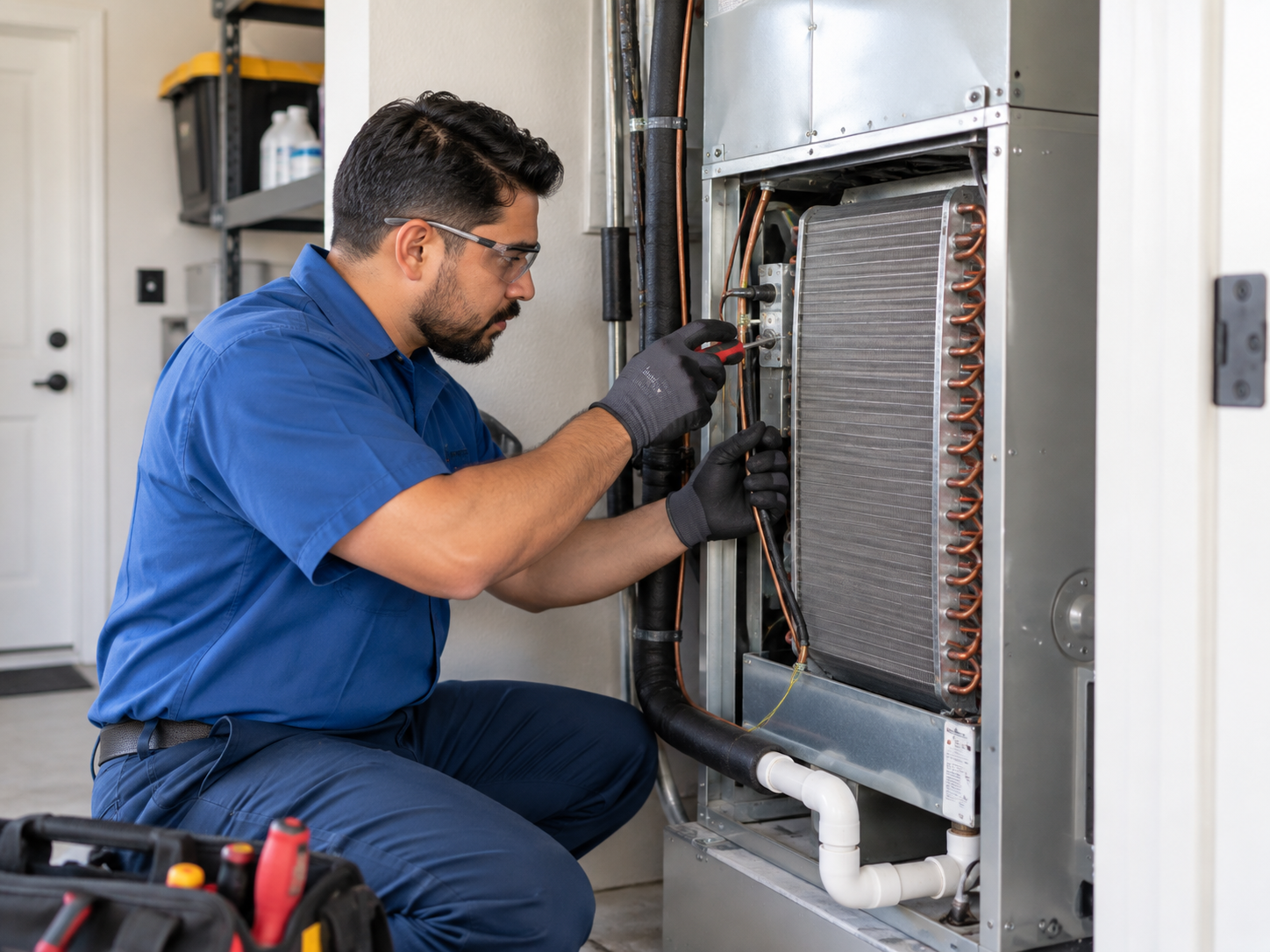
Installation projects can cover new construction, additions, first-time central air in a home that used window units, and full system changeouts. Many providers begin with a load calculation instead of a rule of thumb, because oversizing is a common installation mistake in humid coastal climates.
Sizing for a hot, humid coastal climate
Brownsville sits in a hot-humid climate zone. An oversized system cools the air to setpoint quickly, shuts off, and may not run long enough to pull moisture out — leaving a house that feels clammy at 74°F and can encourage mold in closets. A correctly sized system tends to run longer cycles at lower capacity and controls humidity as well as temperature.
A Manual J load calculation accounts for square footage, orientation, window area and glazing, insulation levels, infiltration, duct location and occupancy. The tonnage estimator on this page gives a rough starting figure so you can sanity-check any quote you receive from a provider.
What a complete installation often includes
- Manual J load calculation and equipment selection matched as an AHRI-certified pair
- Removal and responsible recovery of refrigerant from the old system
- New or flushed line set, correctly sized for the equipment and line length
- Nitrogen purge during brazing to help prevent internal oxidation and future restrictions
- Deep vacuum with a decay test before charging
- Weighed-in refrigerant charge, verified by superheat and subcooling
- Level, elevated condenser pad and tie-downs where required
- New float safety switch, properly pitched condensate drain and secondary pan
- Thermostat installation, blower speed setup and airflow measurement
- Permit handling where required and commissioning documentation
Equipment choices worth understanding
Single-stage equipment is generally the least expensive and can work acceptably in a well-sized, well-ducted home. Two-stage and variable-capacity systems run longer at lower output, which in this climate can translate into better humidity control and quieter operation. Variable-speed blowers also tend to handle duct static pressure more gracefully in older Brownsville homes with undersized returns.
Higher SEER2 ratings may reduce operating cost, and because the cooling season here runs many months of the year, the payback period can be shorter than in milder climates, though actual savings vary. The savings estimator on the cost page can offer a rough sense of what an efficiency upgrade might be worth on your bill.
Ductwork is part of the system
Installing high-efficiency equipment onto leaky attic ductwork can waste much of what you paid for. Duct leakage is common in older homes, and in a Brownsville attic that can become extremely hot, every leak pulls heated, humid air into the system. Duct inspection, sealing and return-air sizing are worth evaluating as part of any installation quote rather than treated as an afterthought.