Skip to content

24/7 Emergency AC Help in Brownsville — Call 956-305-0270

Air Conditioner Repair Brownsville TX logo

Available 24/7 for emergency requests

Central Air Conditioner Repair in Brownsville, TX

Most Brownsville homes cool with a split central system: an outdoor condensing unit connected by refrigerant lines to an indoor air handler or furnace coil, with conditioned air distributed through ductwork. When any one part of that chain fails — electrical, mechanical, refrigerant or airflow — the whole system stops delivering cold air.

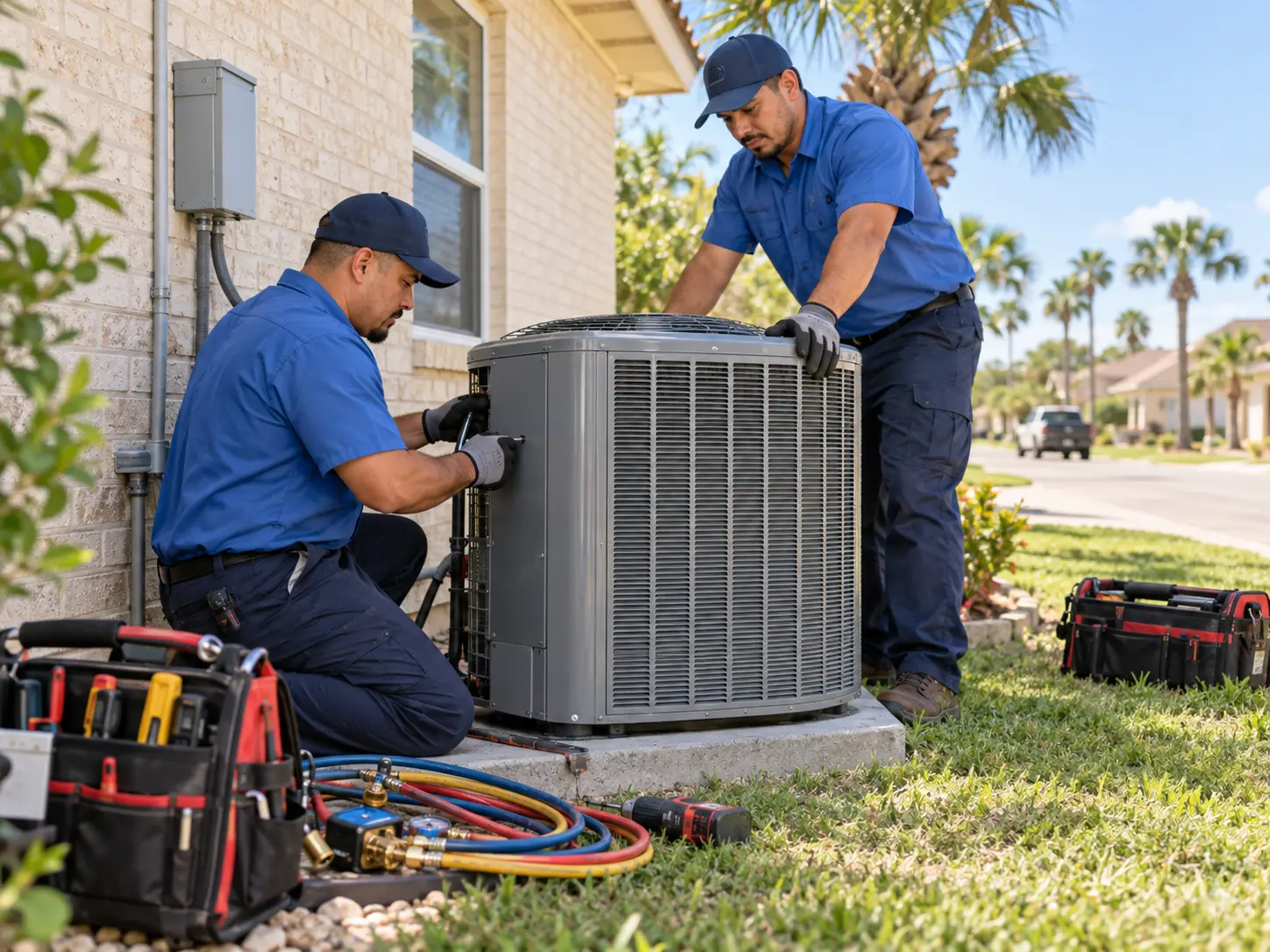
Two HVAC workers servicing an outdoor condensing unit beside a brick home

Central AC diagnosis generally relies on measurement rather than guesswork: supply and return temperature split, static pressure, suction and liquid line pressures, superheat and subcooling, amp draw on the compressor and blower, and capacitor readings. Those numbers help separate a lower-cost electrical part from a refrigerant or compressor problem. A responding HVAC professional can walk you through the findings before recommending repairs.

Central system components that fail most often

  • Run and start capacitors — a common failure point in hot climates
  • Contactors and relays that carry high-current switching every cycle
  • Condenser fan motors, which run nearly continuously through a Valley summer
  • Blower motors and ECM control modules in the air handler
  • Evaporator and condenser coils, prone to corrosion and pinhole leaks
  • TXV or metering devices that restrict or overfeed refrigerant
  • Condensate pans, drain lines and float safety switches
  • Control boards, transformers, and low-voltage thermostat wiring

A typical diagnostic process

  1. 1Confirm the complaint and check thermostat programming, mode and batteries.
  2. 2Verify power at the disconnect, breaker and control transformer.
  3. 3Measure return and supply air temperatures; a healthy split is roughly 16–22°F.
  4. 4Inspect the filter, coil surfaces and blower wheel for airflow restriction.
  5. 5Read refrigerant pressures and calculate superheat and subcooling against the manufacturer's chart.
  6. 6Test capacitors, contactor, and motor amp draws under load.
  7. 7Inspect the condensate path and safety switch.
  8. 8Present the findings, the repair options, and the estimated cost before any work begins.

Why Brownsville is hard on central systems

Equipment here does not get much of an off-season. A system installed in Brownsville may run some cooling load in every month of the year, accumulating substantially more runtime than the same unit in a northern state. Combined with humidity that regularly stays high and airborne salt from the Gulf, the practical result is often faster capacitor degradation, more coil corrosion, wetter drain pans that grow biological slime, and more frequent condensate shutdowns.

That climate reality is also why regular maintenance may pay for itself over time; a cleaned condenser coil and a verified refrigerant charge can meaningfully affect how long a system lasts, though actual results vary by equipment and use.

Repairs that may be worth doing versus systems worth replacing

A capacitor, contactor, drain clearing or fan motor repair on a newer system is often worth doing. A compressor or evaporator coil replacement on an older R-22 unit may not be, depending on cost and condition. The repair-or-replace calculator applies a common age-times-cost guideline plus repair history so you can see where your system falls before you commit — treat it as an educational planning tool rather than a quote.

Free planning tool

Estimate before you commit

Interactive estimates built around Brownsville-area pricing and climate conditions. Use them to sanity-check any quote.

Repair or Replace Calculator

Uses the common $5,000 rule (system age × repair cost) alongside repair history and refrigerant type to show where your system falls.

Age × repair cost = 14,400 (above the $5,000 guideline)

It's a close call — compare both quotes

A repair can be reasonable here, but ask for the replacement number too so you can compare cost per remaining year of service.

Read the full repair vs replace guide

This tool is a decision aid, not an inspection. Duct condition, warranty status, home size and how long you plan to stay in the home all affect the right answer.

Call 956-305-0270 to request service

AC Emergency in Brownsville?

If your home is heating up, the breaker keeps tripping, or the system is making loud mechanical noises, don't wait it out. Calls and service requests are accepted 24 hours a day.

FAQ

Central AC Repair questions from Brownsville homeowners

How long does a typical central AC repair take?

Many electrical and drain repairs are completed within one to two hours of arrival. Coil, motor and compressor work can take several hours or require a return trip if a part must be ordered.

What temperature difference should I feel at the vents?

Measured at the supply register versus the return grille, a properly operating system typically produces roughly a 16 to 22 degree drop. Much less usually points to low charge, poor airflow or a failing compressor.

Can I repair a central AC myself?

Filter changes, drain flushing and thermostat batteries are homeowner tasks. Anything involving refrigerant requires EPA Section 608 certification by law, and capacitors can hold a dangerous charge even with the power off, so that work is best left to a qualified technician.

Do responding technicians work on package units and heat pumps too?

Many do. Package units common on some Brownsville homes and small commercial buildings, and heat pumps used for the short winter season, use similar refrigeration and electrical fundamentals to split systems.

Service area

Serving Brownsville and the Lower Rio Grande Valley

Requests are accepted from Brownsville and surrounding communities including Los Fresnos, Olmito, Rancho Viejo, San Benito, Harlingen, Port Isabel and South Padre Island.

CALL 24/7REQUEST SERVICE