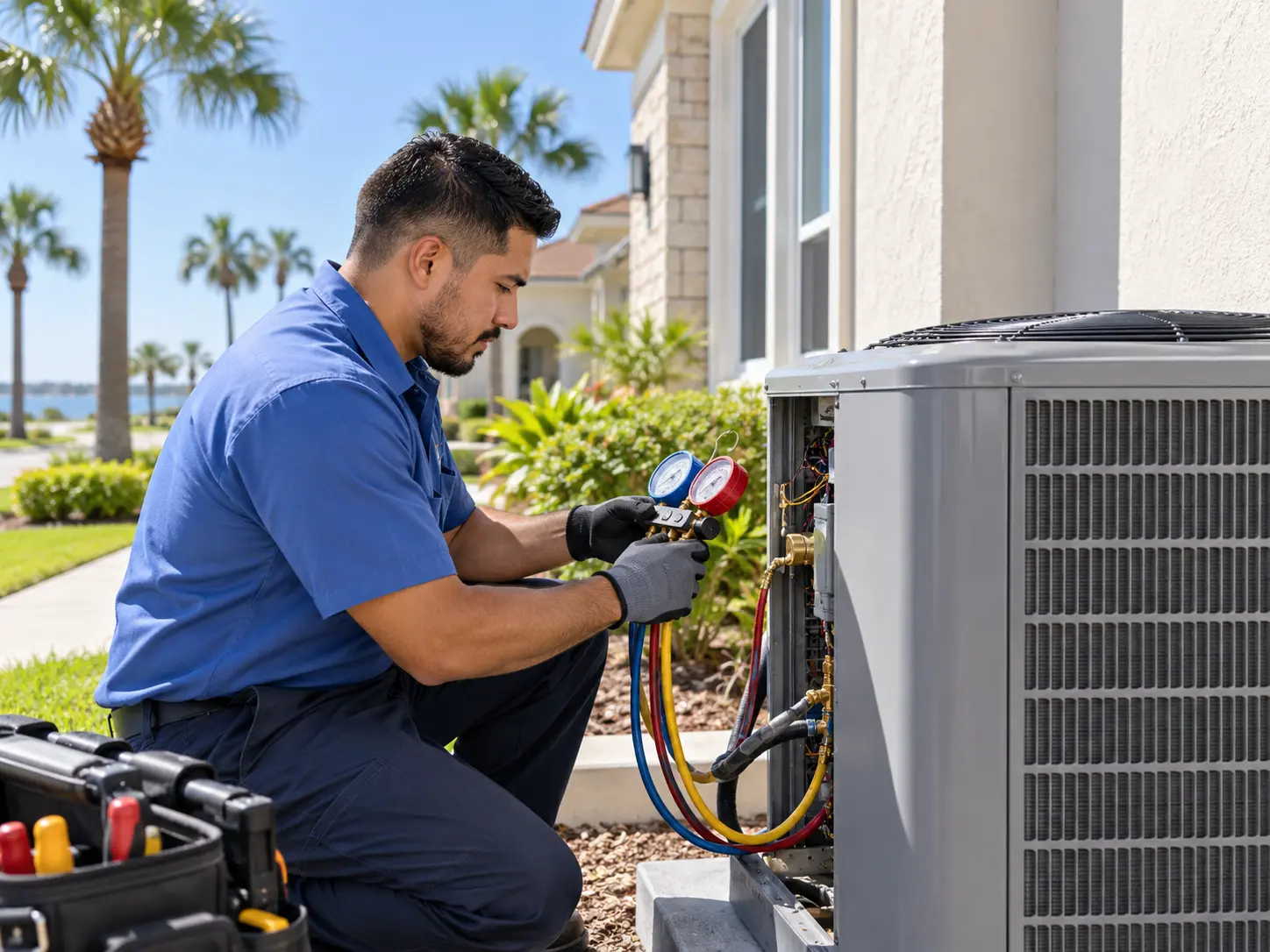
Genuine compressor failure does happen, and it can happen sooner in Brownsville than in cooler regions because of the high number of run hours and the elevated head pressures that come with very warm ambient temperatures.
Signs of compressor trouble
- The outdoor unit hums loudly for a moment and then shuts off on overload
- Breaker trips whenever the outdoor unit tries to start
- Loud mechanical grinding, knocking or rattling from the condenser
- The unit runs but the refrigerant pressures barely change between the lines
- Cooling that gets progressively weaker across a single hot afternoon
- Repeated short cycling on the internal thermal overload
Diagnosis before condemnation
- 1Verify incoming voltage under load — low voltage can damage compressors and is often the actual culprit.
- 2Test the run and start capacitor; a weak capacitor is a common cause of a hard-starting compressor.
- 3Inspect the contactor for pitting or welded contacts.
- 4Measure compressor amp draw against locked rotor and rated load amps.
- 5Perform a winding resistance and ground test on the compressor terminals.
- 6Read suction and discharge pressures to help confirm whether the compressor is actually pumping.
- 7Only after steps like these does compressor replacement typically become the recommendation.
Replacement versus new system
Replacing a compressor is labor-intensive: recovery, removal, brazing, a new filter drier, deep evacuation and a weighed charge. Parts and labor vary widely by system and provider; ask the responding provider for a current estimate. On an older system, that figure can approach a meaningful share of the cost of a complete, more efficient replacement that comes with a full warranty and a fresh service life.
If the compressor is still under a manufacturer's parts warranty, the picture changes — you may pay labor and materials rather than the part. Check the warranty status by serial number before deciding. The repair-or-replace calculator can help frame the comparison as an educational planning tool.
What can shorten compressor life
- Chronic low refrigerant charge from an unrepaired leak (poor motor cooling)
- Liquid refrigerant returning to the compressor from a low-airflow or overcharged system
- Dirty condenser coils driving head pressure and discharge temperature up
- Weak capacitors forcing long, high-current start attempts
- Voltage sags and surges, especially during summer grid stress
- Acid and moisture in the system after an unaddressed burnout or a prior repair issue